Book at the private practice Call Contact
Landschaftsbild – Sinnbild für Ruhe und Beständigkeit
Time, calm and space.
MRI for claustrophobia · Munich

More room to breathe.

MRI with a wide bore and short magnet.

Claustrophobia is common – and nothing to be ashamed of. We take our time, go through the examination with you calmly and adapt to your pace. No one can promise that the anxiety will not arise at all – but we can promise to take it seriously.

Private patients & self-payers · appointments usually at short notice – emergencies accommodated – call us
Short magnet · wide bore
For the knee, ankle and foot, the head often stays outside
Call button
always in your hand
At any time
in contact with us
Breaks
possible between scans
Consultant-led private practice
No X-ray radiation
Time for your questions – before and after
Centrally located near Stachus
What matters to us
What matters

You are not alone in this.

Confined space, noise, the feeling of not being able to get up straight away: it is understandable that an MRI causes unease. In a large study, almost one in ten people experienced a claustrophobic reaction during the examination (claustrophobia – the fear of narrow, enclosed spaces).¹ What helps then is often simple: knowing what to expect, and being heard at any time.

MRI for claustrophobia in Munich – for private patients and self-pay patients, even if the “tube” makes you anxious.

Does this sound familiar?

When confined spaces trouble you

  • Lifts, tunnels or crowded trains make you uncomfortable
  • Even the thought of the “tube” makes you uneasy
  • You found a previous MRI examination distressing – or had to stop it
  • You have a referral for an MRI and keep putting off the appointment
  • You fear the noise or the feeling of not being able to get away

All of this is understandable. Feel free to tell us when you book – then we will plan more time for you.

What helps

What can make the examination easier

Claustrophobia cannot simply be talked away. But many things can help you cope with it.

Sedative or someone at your side

On request, after consultation with a doctor, you can be given a sedative (drops) – or a member of our team can stay with you in the examination room. After taking a sedative you must not drive yourself on the same day; please arrange for someone to accompany you home.

Wide bore, short magnet

Our MRI is a closed scanner – with a wide bore and a short magnet. This leaves more space around you. For the knee, ankle and foot you usually lie feet first, so your head often stays outside.

Open MRI? Our alternative

Many people look for an open MRI. We deliberately use a closed scanner with a wide bore and a short magnet: it offers more space than older tubes, for knee, ankle and foot your head usually stays outside – and closed scanners generally deliver higher image quality than open ones. Add to that company, breaks and, if you wish, a sedative.

Ear protection or headphones

The MRI works with loud knocking noises. You will receive ear protection or headphones, and we will tell you beforehand what you are going to hear.

Call button, breaks, calm breathing

You hold a call button in your hand and can talk to us at any time; breaks between scans are usually possible. Some people also find it helpful to close their eyes before moving into the scanner and to breathe out slowly – we will gladly show you a simple breathing exercise.

How it works

Three steps – at your pace

Choose an appointment

Online or by phone – appointments at short notice, emergencies accommodated. Call us.

Arrival & examination

We show you the scanner and explain every step. The examination itself usually takes 20–30 minutes.

Findings & consultation

The specialist discusses the images with you – on request, the report goes directly to your treating doctor.

For referring colleagues

For patients with claustrophobia: modern MRI with a wide bore and short magnet and time for preparation, read by a specialist in radiology and neuroradiology. Feel free to note the claustrophobia on the referral. Images sent directly into your system on request.

Your doctor

Personally there for you

Dr. Dr. Georg-Friedemann Rust – Facharzt für Radiologie und Neuroradiologie

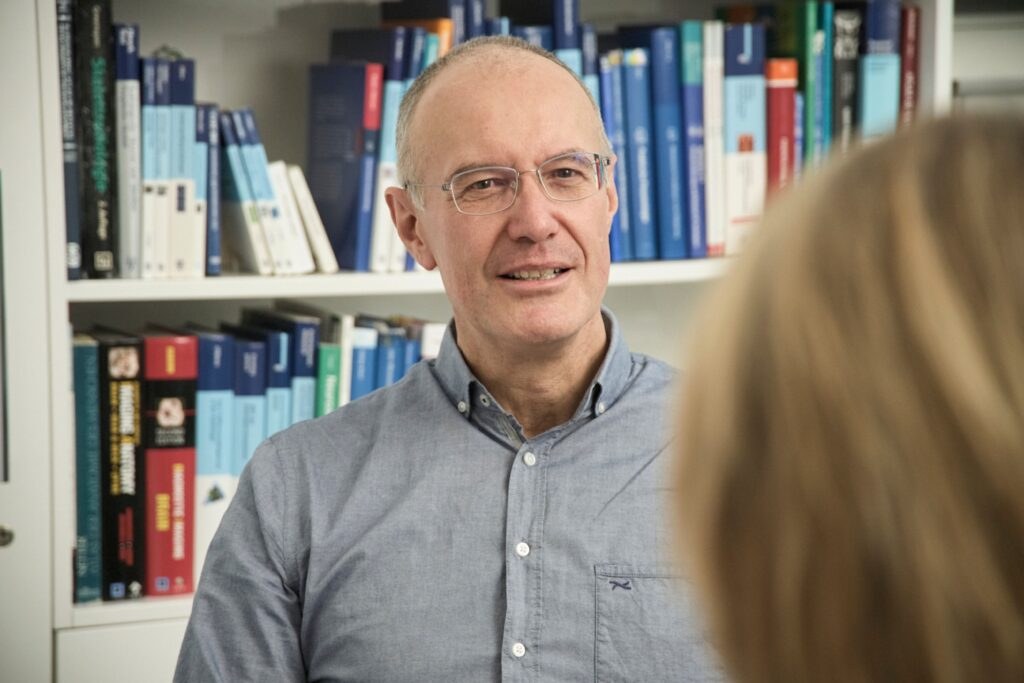
Dr. Dr. Georg-Friedemann Rust

Specialist in Radiology & Neuroradiology

Physicist and radiologist – combining medical and technical expertise for precise imaging and personal care.

What our patients say

Trust that grows from experience

★★★★★  92 × 5-star reviews on Google

Google
★★★★★
“A doctor and physicist who combines the highest professional competence with a very pleasant manner – the patient is at the centre, and the findings are explained in an understandable way.”
Thomas S. · Google
Google
★★★★★
“Competent, attentive, thorough. He helps where other doctors fail.”
Jonas S. · Google
Google
★★★★★
“He conveyed the findings factually, calmly and clearly. A welcome angel after days of panic over an orthopaedist’s preliminary finding.”
Verifizierter Patient · Selbstzahler · Google
Google
★★★★★
“I have been coming here for years – always reliable, friendly and professional. The team takes its time.”
Firat S. · Google
Google
★★★★★
“No waiting time, short-notice appointments, very competent. The best radiology practice in Munich!”
Svetlana M. · Google

MRI in calm – book your appointment now

Choose the way you prefer. We will get back to you reliably.

In a study of 6,520 patients, 9.8 per cent experienced a claustrophobic reaction during the examination that required additional support or led to it being stopped; who would be affected could not be reliably predicted in the individual case.¹ Stopping the examination is considerably rarer: a meta-analysis of 18 studies arrives at about 1 in 100 examinations.² In a cohort study of more than 55,000 patients, claustrophobic reactions occurred more often when patients were scanned head first, as well as in women and in middle age; in a newer scanner with a short bore and considerably lower noise level they were less frequent than in a conventional scanner (0.7 versus 2.1 per cent).³ The design alone is no guarantee, however: in a randomised study of 174 people with an increased tendency to claustrophobia, the examination could not be completed in more than a quarter of cases both in the short-bore scanner and in a scanner with no tube at all; the difference was not statistically significant.⁴ In several studies, clear information and simple breathing and relaxation techniques reduced tension before an examination; the evidence, however, is still limited.⁵ That is why we rely on both: a suitable scanner – and time for you.

References
  1. Napp AE, Enders J, Roehle R, et al. Analysis and prediction of claustrophobia during MR imaging with the Claustrophobia Questionnaire: an observational prospective 18-month single-center study of 6500 patients. Radiology 2017;283(1):148–157. doi:10.1148/radiol.2016160476 pubs.rsna.org
  2. Munn Z, Moola S, Lisy K, Riitano D, Murphy F. Claustrophobia in magnetic resonance imaging: a systematic review and meta-analysis. Radiography 2015;21(2):e59–e63. doi:10.1016/j.radi.2014.12.004 salford-repository.worktribe.com
  3. Dewey M, Schink T, Dewey CF. Claustrophobia during magnetic resonance imaging: cohort study in over 55,000 patients. J Magn Reson Imaging 2007;26(5):1322–1327. doi:10.1002/jmri.21147 doi.org
  4. Enders J, Zimmermann E, Rief M, et al. Reduction of claustrophobia with short-bore versus open magnetic resonance imaging: a randomized controlled trial. PLoS One 2011;6(8):e23494. doi:10.1371/journal.pone.0023494 journals.plos.org
  5. King S, Woodley J, Walsh N. A systematic review of non-pharmacologic interventions to reduce anxiety in adults in advance of diagnostic imaging procedures. Radiography 2021;27(2):688–697. doi:10.1016/j.radi.2020.09.018 uwe-repository.worktribe.com
Book Call Contact
Farbstimmung
Wählen Sie die Ansicht, die Ihnen am angenehmsten ist.