
Termin buchen Anrufen Kontakt
Eiche auf weiter Wiese – Sinnbild für Souveränität und Beständigkeit
Better to catch it early than chase it late.
Radiological diagnostics · Munich

Whole-Body MRI

Certainty, at last. Without X-rays. Calmly and with time.

A whole-body MRI provides a thorough overview of the body – especially when there is an elevated risk or when concrete concerns call for clarity.

Our promise
When a whole-body MRI makes sense

Two good reasons to look closer

A specific suspicion is not always needed – looking early and thoroughly gains time and treatment options.

With elevated risk

In cases of familial or genetic predisposition, a structured examination can be important. For hereditary tumour predisposition syndromes, whole-body MRI is an internationally recommended part of surveillance.¹ ²

With concrete concerns

When symptoms or worries are present, whole-body MRI offers a calm, thorough overview – often the first step towards certainty, without radiation and without intervention.

Our standard

Thorough, gentle, at a high level

Without X-rays

MRI works with magnetic fields instead of ionising radiation.

Diffusion-weighted sequences

We examine with the familiar prirad standard – including diffusion-weighted sequences.

Internal-medicine assessment on site

If an incidental finding needs further clarification, internal-medicine assessment is available in our practice – short distances, one point of contact.

What this is really about

From head to pelvis in a single session – with one goal: certainty.
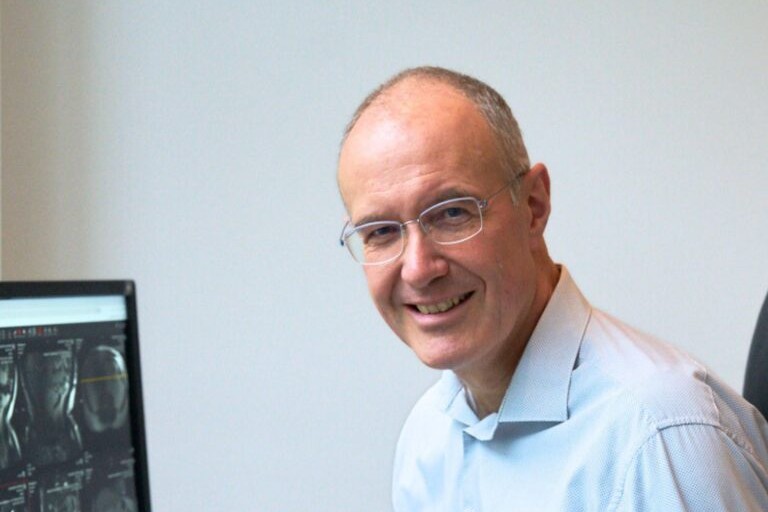
Dr. Dr. Georg-Friedemann Rust im Gespräch mit einer Patientin
Your doctor
Prevention does not mean being afraid. It means knowing where you stand.
Dr. Dr. Georg-Friedemann Rust
Specialist in Radiology & Neuroradiology
How it works

Three steps to certainty

Book an appointment

Conveniently online or by phone – you receive an appointment promptly through our friendly reception.

The examination

The scan is performed in a modern, open and short MRI – comfortable even with claustrophobia.

Findings & discussion

You receive a detailed report and a personal discussion of the next steps.

What our patients say

Trust that grows from experience

★★★★★  87 × 5-star reviews on Google

Google
★★★★★
“A doctor and physicist who combines the highest professional competence with a very pleasant manner – the patient is at the centre, and the findings are explained in an understandable way.”
Thomas S. · Google
Google
★★★★★
“Competent, attentive, thorough. He helps where other doctors fail.”
Jonas S. · Google
Google
★★★★★
“He conveyed the findings factually, calmly and clearly. A welcome angel after days of panic over an orthopaedist’s preliminary finding.”
Verifizierter Patient · Selbstzahler · Google
Google
★★★★★
“I have been coming here for years – always reliable, friendly and professional. The team takes its time.”
Firat S. · Google
Google
★★★★★
“No waiting time, short-notice appointments, very competent. The best radiology practice in Munich!”
Svetlana M. · Google

Gain clarity

Arrange your appointment – online in a few steps or by phone.

Disease facts & context

Nearly half of all men and over two in five women develop cancer during their lifetime.³ In 2023, around 230,000 people in Germany died from cancer – 22.4 % of all deaths.⁴ (In the same period, around 348,000 deaths were attributable to cardiovascular disease, 33.9 % of all deaths.⁴ – Coronary heart disease (CHD) accounts for roughly 180,000 to 200,000 of these: about 126,000 are directly due to ischaemic heart disease (CHD),⁵ plus large shares of deaths from CHD-related heart failure (around 37,600)⁶ and CHD-related cardiac arrhythmias (around 30,600).⁵) For people with a hereditary elevated tumour risk, annual whole-body MRI is an internationally recommended part of surveillance and can detect malignant changes in most tumours at an early, more treatable stage.¹ ²

References
  1. Frebourg T, Bajalica Lagercrantz S, Oliveira C, et al. Guidelines for the Li-Fraumeni and heritable TP53-related cancer syndromes. Eur J Hum Genet 2020 (ERN GENTURIS).
  2. Ballinger ML, Best A, Mai PL, et al. Baseline Surveillance in Li-Fraumeni Syndrome Using Whole-Body MRI: A Meta-analysis. JAMA Oncol 2017;3(12):1634–1639.
  3. Robert Koch-Institut, Zentrum für Krebsregisterdaten (ZfKD). Epidemiologisches Bulletin 5/2026, 29. Januar 2026: Krebs in Deutschland.
  4. Statistisches Bundesamt (Destatis), Todesursachenstatistik 2023, Pressemitteilung Nr. N005 vom 30. Januar 2025.
  5. Deutscher Herzbericht (Deutsche Herzstiftung / DGK), Update 2024/2025: Sterblichkeitszahlen ischämische Herzkrankheit und Herzrhythmusstörungen, Datenbasis Statistisches Bundesamt.
  6. Deutscher Herzbericht (Deutsche Herzstiftung / DGK), Update 2025: Herzinsuffizienz 37.645 Sterbefälle (2023); KHK als Hauptursache bei rund zwei Dritteln der Fälle.
Book Call Contact
Farbstimmung
Wählen Sie die Ansicht, die Ihnen am angenehmsten ist.